Diablo 4’s Kurast Undercity Is Still the Gold Standard—and Path of Exile 2 Should Take Notes in 2026
The ARPG landscape has shifted dramatically over the past two years. Once upon a time, fans placed frantic bets on which titan would reign supreme: Diablo 4 or Path of Exile 2. Now, with both games sitting comfortably in the post-launch era (yes, 2026 is here, and PoE2 has been out of early access for a while), the dust has settled enough to make a hilariously unfair comparison. While Path of Exile 2 continues to seduce players with its labyrinthine passive tree and infinite build permutations, it still fumbles the ball when it comes to an endgame that doesn’t feel like a second job. Meanwhile, Diablo 4—especially since the Vessel of Hatred expansion—has been casually waving a loot-filled flag with one piece of content that deserves a standing ovation: the Kurast Undercity time trial. 🎉
The reason this topic smacks us in the face in 2026 is simple. Path of Exile 2 has had multiple leagues to iterate on its mapping system, yet the core pain points remain: brutal punishment for failure, currency sinkholes that can devour a week’s grind in one unlucky T17 map, and a learning curve that makes newcomers uninstall before they’ve tasted their first pinnacle boss. When GGG announced their next expansion, gamers everywhere hoped for a more forgiving, adjustable endgame loop. They were instead handed another layer of complexity that sent spreadsheet enthusiasts into ecstasy but left casual players staring at their portals of shame. In contrast, the Kurast Undercity—introduced alongside the Spiritborn class—has quietly become the poster child for “endgame done right.” Even now, its design philosophy feels like a polite middle finger to the stress factories that PoE2 maps often become.
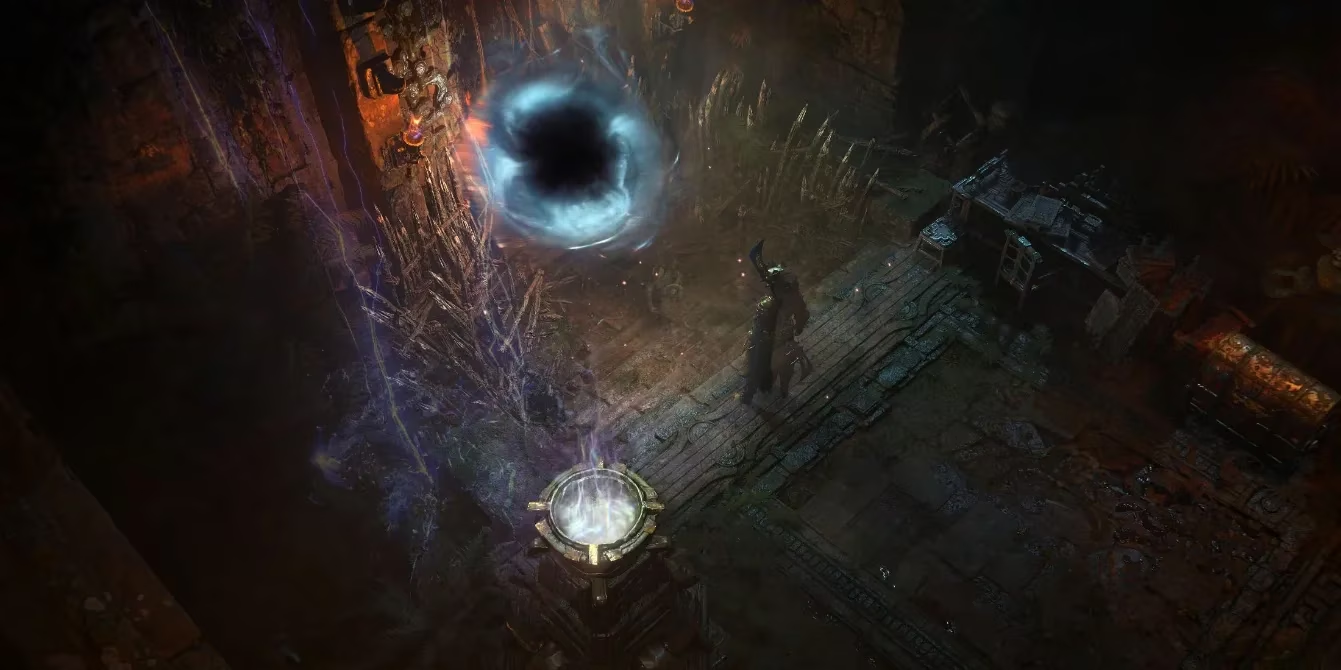
So, what makes the Undercity so delicious? ⚔️ It’s a timed, multi-level dungeon unlocked near the end of the Vessel of Hatred campaign, but that description alone undersells its genius. The activity scales not just by Torment difficulty—though that’s part of it—but through a modular system of rewards and punishments that players control completely. Think of it as a risk-versus-reward slider where you never walk away empty-handed. Want to crank up enemy health, reduce your time limit, or add deadly environmental hazards? Go right ahead. Each tweak boosts the quality and quantity of loot. The harder the run, the fatter the piñata. But here’s the kicker: even if you fail miserably, the game pats you on the back and dumps a pile of gear into your stash. Time is never truly wasted. 🕒💰
That stands in stark opposition to Path of Exile 2’s mapping system. In 2026, a typical high-tier map still demands significant currency investment—rolling mods, chiseling, vaaling, and praying to RNG gods. If a player burns through six portals because a rare monster had a nasty combination of mods, they lose not only the map but all the potential rewards they hadn’t yet scooped up. The best drops are often locked behind the map boss, so a death on the way feels like a kick in the teeth. Newcomers, in particular, tend to hoard their precious maps, too terrified to run them without the perfect setup. The result is an endgame that can feel more like inventory management anxiety than a power fantasy. 😅
Kurast Undercity flips the script entirely. Because the runs are short and infinitely repeatable at no currency cost (yes, free entry in Diablo 4), players experiment fearlessly. They throw on absurd negative modifiers just to see if their build can survive, and if it can’t, they giggle at the chaos and collect a consolation prize. The loot-to-time-investment ratio frequently borders on the absurd, especially when a well-optimized build completes a fully juiced run in under two minutes. This positive reinforcement loop keeps players chasing upgrades without the dread of a “wasted” gaming session. It’s the kind of ergonomic design that respects human psychology—something PoE2 desperately needs as it ages.
Of course, a purist might argue that Path of Exile 2 isn’t supposed to be casual. Its identity is built on depth, trading, and the thrill of overcoming punishing odds. That’s fair. But even the most hardcore fans occasionally crave a break from staring at map mods and currency calculators. An Undercity-style mode—perhaps gated behind a map device and a moderate currency fee—would offer a refreshing alternative without betraying the game’s soul. Imagine dropping a Harbinger Orb equivalent and venturing into a timed zone where you choose your own modifiers: increased pack size for more experience, extra fire damage for better jewellery drops, a shrinking timer for duplicate unique items. Even veterans would flock to such content to test experimental builds or simply unwind after a brutal boss fight. 🌿
In 2026, Diablo 4 isn’t just surviving; it’s thriving precisely because it remembers that players want to feel powerful without being punished for having a life outside the game. The Kurast Undercity encapsulates that philosophy in a tight, replayable package. Multiple classes—both old and new like the Spiritborn—interact with its timer mechanics in delightful ways, and the ever-present loot shower keeps dopamine levels high. Path of Exile 2, with its even larger roster of classes and ascendancies, would benefit enormously from a similar system. It wouldn’t replace maps; it would complement them. A bite-sized, customizable, failure-forgiving activity that rewards skill and experimentation in equal measure. Until GGG introduces something comparable, the Undercity will remain the benchmark—and a quiet reminder that sometimes, the best endgame is the one that lets you play how you want, not how the spreadsheet demands. 😎